Hipóteses do MULTIVERSO
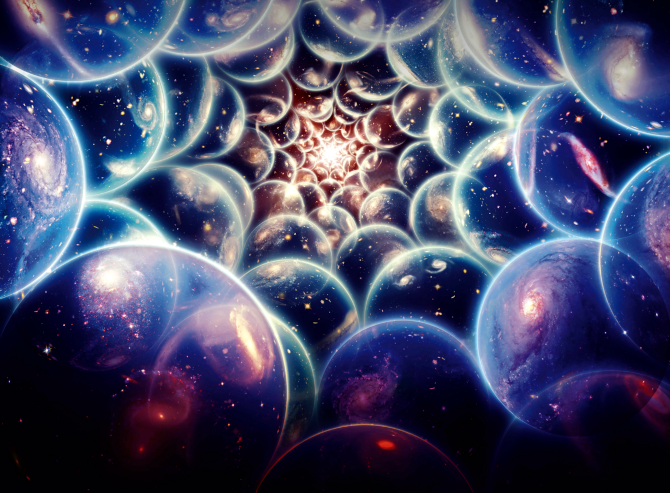

Greene reconhece explicitamente o caráter especulativo do tema, mas argumenta que certos aspectos da hipótese do multiverso podem, sim, ser considerados científicos, uma vez que se baseiam em cálculos matemáticos legítimos e em teorias físicas amplamente aceitas.
Mais radicais são as formulações propostas por Max Tegmark. Em seu livro Nosso universo matemático, ele defende a tese de que tudo o que é matematicamente consistente existe fisicamente. Enquanto Greene trata a matemática como uma linguagem para descrever a realidade, Tegmark a identifica como a própria substância do mundo físico.
Em seu artigo clássico Universos Paralelos (Parallel Universes, 2003), Tegmark classifica quatro níveis de multiverso. Os três primeiros (níveis I, II e III) apresentam forte sobreposição com os tipos discutidos por Brian Greene, enquanto o quarto nível (IV) corresponde ao conjunto de todos os universos matemáticos possíveis, cada um associado a uma estrutura matemática logicamente consistente.
Além de Greene e Tegmark, outros cientistas eminentes que defendem uma ou mais hipóteses envolvendo múltiplos universos incluem: Alan Guth, Alexander Vilenkin, Andrei Linde, David Deutsch, Laura Mersini-Houghton, Leonard Susskind, Michio Kaku, Neil deGrasse Tyson, Raj Pathria, Sean Carroll, Stephen Hawking e Yasunori Nomura.
Entre os opositores mais conhecidos da hipótese do multiverso estão: Adam Frank, Carlo Rovelli, David Gross, George Ellis, Jim Baggott, Joe Silk, Marcelo Gleiser, Paul Davies, Paul Steinhardt e Steven Weinberg.
Nos links a seguir, apresentamos as principais ideias e classificações das diferentes modalidades de universos paralelos:
Multiverso cosmológico
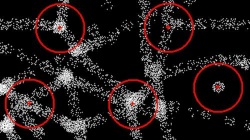
via Wikimedia Commons]
Multiverso quântico

Multiverso paisagem

via Scientific Visualization Studio]
Multiverso matemático
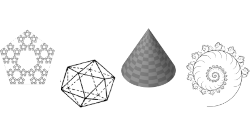
espiral criado por IA]
★ Edição: Mauro Mauler - Publicado originalmente em 18/03/2024 - revisto e atualizado em 21/01/2026.
★ Referências:
- CARROLL, Sean M. Something Deeply Hidden: Quantum Worlds and the Emergence of Spacetime. New York: Dutton, 2019.
- DEUTSCH, David. A essência da realidade. 1.ed. São Paulo: Pearson Education, 2000.
- ELLIS, George F. How Can Physics Underlie the Mind?: Top-Down Causation in the Human Context. Berlim: Springer, 2016.
- ELLIS, George F. R. Issues in the Philosophy of Cosmology, v2. arXiv, 13/02/2006 (revisão 29/03/2006).
- GREENE, Brian. A realidade oculta: universos paralelos e as leis profundas do Cosmo. 1.ed. São Paulo: Companhia das Letras, 2012.
- GUTH, Alan H. The Inflationary Universe: The Quest for a New Theory of Cosmic Origins. New York: Basic Books, 1997.
- HAWKING, Stephen. O universo numa casca de noz. 1.ed. São Paulo: Editora Mandarim, 2001.
- HAWKING, Stephen W.; HERTOG, T. A Smooth Exit from Eternal Inflation?, v3. arXiv, 24/07/2017 (revisão 20/04/2018).
- LINDE, Andrei. The self-reproducing inflationary universe. Scientific American, [s.l.], v. 271, n. 5, p. 48-55, nov. 1994.
- SMOLIN, Lee. The Trouble with Physics: The Rise of String Theory, the Fall of a Science, and What Comes Next. Boston: Mariner Books, 2007.
- SMOLIN, Lee. Time Reborn: From the Crisis in Physics to the Future of the Universe. New York: Houghton Mifflin Harcourt, 2013.
- TEGMARCH, Max. Our Mathematical Universe: My Quest for the Ultimate Nature of Reality. Ed. ilustrada. New York: Vintage, 2015.
- TEGMARCH, Max. Parallel Universes, v1. arXiv, 07/02/2003.
- TEGMARCH, Max. The Mathematical Universe, v2. arXiv, 05/04/2007 (revisão 08/10/2007).
- TEMPLE, Robert. Multiple Universe (Dialogue with David Deutsch). Second Look Magazine, jul. 1979.
- VILENKIN, Alexander. Many Worlds in One: The Search for Other Universes. New York: Hill and Wang, 2006.
- WITTEN, Edward. String Theory Dynamics In Various Dimensions, v2. arXiv, 20/03/1995 (revisão 24/03/1995).

[Introdução] [1] [2] [3] [4]